Engineering seasonal energy storage for the renewable era

Elina Koivisto
An interview with Photoncycle’s Chief Science Officer Sebastian Gutterød
Renewable energy has a structural timing problem. Solar energy is abundant in summer and limited in winter, while household demand follows the opposite pattern. Most storage technologies available to homeowners today are designed to shift energy across hours, not months.
Creating a year-round, energy-independent energy system for homes is one of the most demanding challenges in the renewable transition. Solar energy is abundant in summer and scarce in winter. Most storage technologies available to homeowners today are fundamentally limited in capacity. A typical residential battery system stores around 10 to 20 kWh of electricity, which is sufficient for shifting energy from day to night. However, this level of capacity is not designed to store the large volumes of energy required across seasons.
Photoncycle’s underground storage unit, by comparison, can store up to 10,000 kWh of energy, enabling summer energy to be used months later when demand is highest.
At Photoncycle, the scientific responsibility for solving this challenge lies with Sebastian Gutterød, Chief Science Officer and the company’s first employee. In this interview, he explains how Photoncycle is turning research and development into a practical, system-level solution for households.
“The Photoncycle system combines several proven technologies such as electrolysis, hydrogen storage, fuel cells, and heat pumps,” Sebastian explains. “The main challenge is not the individual technologies themselves but integrating them into one system that works reliably throughout the year. Seasonal storage is inherently interdisciplinary. No single discipline can solve it in isolation.”
One system, many disciplines
Seasonal energy storage is inherently interdisciplinary. It requires chemistry, mechanical design, thermal management, electro-chemical processes, electrical engineering, and software control to work together seamlessly.
“Thermal engineers focus on optimizing heat flows, mechanical engineers design mechanically sound solutions, chemical engineers develop the conversion processes, control and electrical engineers handle the control and power systems,” Sebastian says. “On top of that, the system needs to interact intelligently with the home and communicate with the grid.”
As Chief Science Officer, Sebastian holds the full system overview. His role is to ensure that no component is developed in isolation and that every decision improves the performance, safety, and efficiency of the complete energy system.
“It’s an integration of many different elements. When developing materials for subsystems, the goal isn’t just to optimize the performance of that specific material or technology, but to consider how it functions within the entire system.”

From academic research to building the lab
Sebastian holds a PhD in process-related chemistry from the University of Oslo, where his research focused on catalysis and hydrogen-based reactions. After several years in academia, he wanted to apply his knowledge beyond theoretical models, translating it into practical solution.
That opportunity came in 2021, when Photoncycle founder Bjørn Brandtzæg reached out with an idea that immediately resonated with him.
“Bjørn's idea and the potential impact it could have—if we were able to make it technically and commercially feasible—was very appealing to me. It wasn’t just the technical challenges that drew me in, but the mission and the broader impact the company could have.”
Sebastian joined Photoncycle as its first employee and took responsibility for establishing the company’s laboratory in Oslo from the ground up. He led early material validation, defined testing methodologies, and drove the design and construction of Photoncycle’s first full-scale systems.
“From the beginning, the question was not only whether it could work — but whether it could be made robust, scalable, and suitable for residential infrastructure. Everything we’ve done since has been about answering that.”
How Photoncycle stores energy
Photoncycle stores excess solar energy as solid-state hydrogen, where hydrogen is safely bound inside a solid material instead of being stored as compressed gas or liquid. This enables storage at low pressure and near ambient temperatures, enabling storage at low pressure and near ambient temperatures, which simplifies system design and enhances operational safety.
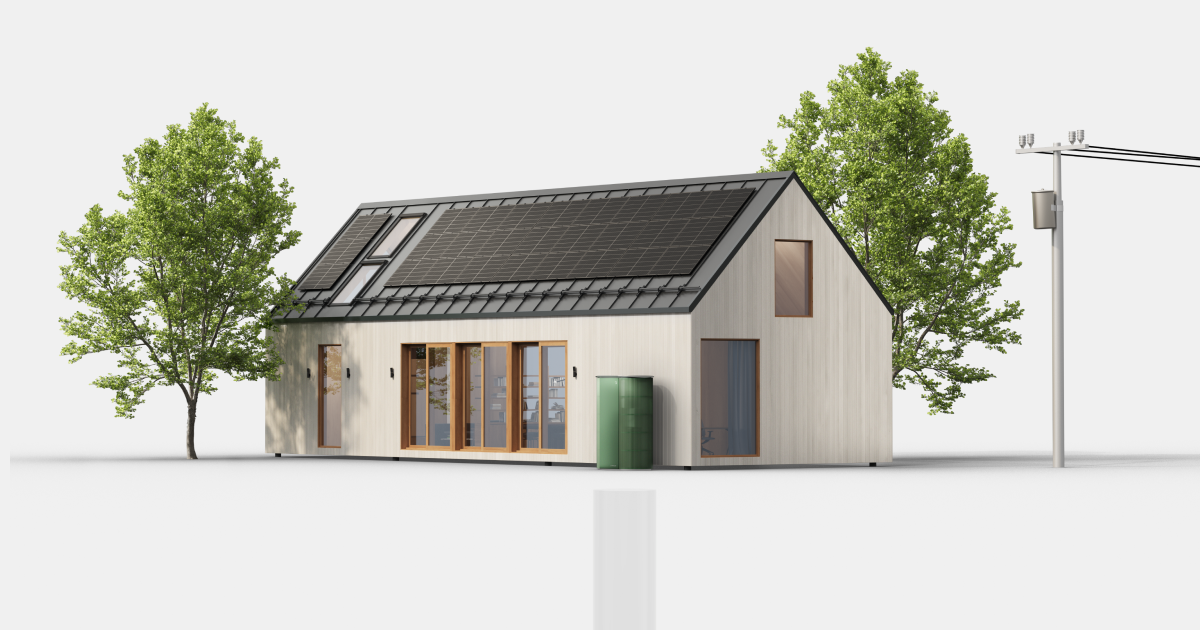
In a standard residential installation, Photoncycle’s underground storage unit of around 3 cubic meters can store up to 10,000 kWh of energy. This makes it possible to store energy generated during summer months and use it later in the year, when heating and electricity demand is highest.
“The material absorbs hydrogen at a molecular level,” Sebastian explains. “That allows us to store energy compactly and safely for months at a time, which is what seasonal storage requires.”
When energy is needed, hydrogen is released in a controlled way and converted back into electricity and heat through a fuel cell. A heat pump increases overall system efficiency, ensuring that both electrical power and usable heat are delivered to the home. Hydrogen is only released when energy is needed, and only in controlled quantities. The storage itself remains in solid form under normal conditions, making the storage inherently self-limiting and safe by design.
Incremental, hands-on development
While solid-state hydrogen storage has been studied for years, Photoncycle’s focus has been on making it work at residential scale through careful, incremental development.
“We started with gram-scale validation, then moved to kilo-scale systems, and now to tens of kilos per storage unit,” Sebastian says. “Each step gives us real-world data that feeds directly into the engineering. This hands-on development ensures that our practical experience directly informs the rest of the engineering process.”
That approach has now reached an important milestone. Photoncycle’s full-scale pilot unit is live and operational, bringing together core subsystems in an integrated configuration. Rather than testing components in isolation, the team is now evaluating how the system behaves as a whole, including control strategies, thermal management, conversion processes, and operational stability.
The pilot represents a transition from material and component validation toward engineered system architecture. It marks a shift in focus: from proving that individual technologies work, to engineering how the complete system performs as a coherent and robust unit.
“It allows us to demonstrate the system’s functionality at meaningful scale,” Sebastian explains. “This is a major step toward production-ready units.”
The objective has never been to demonstrate a laboratory concept alone, but to design a system capable of long-term, stable operation in residential settings. The pilot enables Photoncycle to refine integration, safety mechanisms, and performance characteristics as the company moves closer to scalable deployment.
Engineering seasonal storage for the energy transition
As renewable generation increases, long-term storage becomes a structural requirement rather than an optional add-on. Batteries are highly effective for short-term storage, yet they are not designed to store large amounts of energy across seasons.
“Distributed, long-term energy storage can solve many of the challenges the energy system faces today,” Sebastian says. “Producing renewable energy is no longer the main problem. Storing it efficiently, safely, and at the right scale is where real value is created.”
With a 10,000 kWh seasonal storage capacity, a fully integrated conversion chain, and a live full-scale test unit, Photoncycle is moving seasonal energy storage from theory to engineered reality.
With large-scale seasonal capacity, integrated conversion architecture, and an operational pilot system, Photoncycle is advancing seasonal energy storage from research concept to engineered reality. For homeowners, this means access to a system designed from the ground up to provide reliable, year-round energy autonomy.
Key characteristics of the Photoncycle system
• Seasonal storage capacity of up to 10,000 kWh per home
• Solid-state hydrogen storage at low pressure and near ambient temperature
• Integrated production of both electricity and heat
• Designed for safe, distributed, long-term energy storage